Method
How we tested confidence, cost and accuracy
We tested 55 models in 74 setups on a reading comprehension and grammar test in native Turkish (not translated): 2,198 questions. A setup is one model with one set of settings. We measured four things: how often each was right, whether its confidence found the answers worth keeping, whether it answered the same way again, and its cost and time.
This page covers the Text tab. The other two tabs explain their own methods on their pages: Page images under How the benchmark was run and Hallucination under Our method.
At a glance
Three benchmarks, each on its own tab and ranked on its own; no score combines them.
| Benchmark | Questions | What it measures | Main measure |
|---|---|---|---|
| Text | 2,198 | Reading comprehension and grammar, in native Turkish | Accuracy: right answers over the questions |
| Page images | 763 | Questions that point at underlined or numbered words: from the text (A), a picture of the page (B), both (C) or an OCR model's reading (D) | Accuracy in each condition |
| Hallucination | 2,198 | The Text tab's questions with a sixth option, “Bilmiyorum” (I don't know) | Non-hallucination rate: “Bilmiyorum” over “Bilmiyorum” plus wrong answers |
How we ask the models
- Decision models: each question goes to the model with its lettered options; we use only its pick and its score for each option (Models and setups).
- Chat models: asked in Turkish for their answer's letter and, where needed, a confidence score, in a structured reply (What we sent).
Text
- Measures: how often each setup was right, whether its confidence found the answers worth keeping, whether it answered the same way again, and its cost and time.
- Questions: 656 Reading and 1,542 Grammar questions in 20 topics, answer key version 2 (The questions).
- Scoring: accuracy with its 95% interval; the ranking score and the calibration gap for confidence; cost per 1,000 questions at list prices; median latency per request (How we measure).
- Details: the sections below.
Page images
- Questions: 763 of the Text tab's questions: 229 at underlined words and 543 at numbered words.
- Scoring: accuracy in each condition over the 763 questions; two conditions of a model compared with the exact McNemar test on the same questions.
- Details: How the benchmark was run, on the tab.
Hallucination
- Questions: the Text tab's 2,198 questions, each with “Bilmiyorum” as option F, never correct, and one added sentence in the instructions.
- Scoring: accuracy, attempt rate and the non-hallucination rate; for comparison, the same model's five-option run held back by its own confidence at about the same attempt rate.
- Details: Our method, on the tab.
Version history
Every results version and what changed: the results changelog; changes to the answer key: the key changelog.
What we found
No model led on every measure: accuracy, ranking answers by confidence and confidence that matches the hit rate are separate strengths. Gemma 4 31B, a chat model, scored higher than every decision model except d1-ultra on Reading (90.9%) and Grammar (65.6%), but its confidence matched its hit rate less closely than the best decision models' did.
How a model gives its confidence matters. GPT-6 Luna through OpenAI's Decisions API ranked its answers better than Luna writing its confidence (ranking score 0.82 against 0.69) but got fewer right (63.6% against 68.3%), with a different access method and request size. Among decision models, its calibration gap (2.4 points) was second only to Liquid d1.1's (2.0 points).
Cheaper chat models remain alternatives. GPT-6.1 Sol scored 96.7% at an estimated cost 79% below GPT-6 Astra's (97.6%). Gemini 3.8 Flash at high reasoning scored 98.1%, and the test over all pairs did not establish a difference from Astra.
Erk-14B is Qwen3-14B with extra Turkish training by eCloud. Its calibration gap was 13.5 points against 41.0 for its base, with no accuracy difference detected (45.0% against 45.7%); the training may have changed more than language knowledge.
On Artificial Analysis' Decision Index (English tasks), Jev 1.13 leads with 58, ahead of GLiDE and Microsoft-Decision-1 (54). Our order differs. In both tests, confidence is less reliable on some question types: knowledge and reasoning there, grammar here.
The questions
The test has 656 Reading and 1,542 Grammar questions in 20 topics, so 70% are Grammar. These results cover this question bank only. We did not test whether they hold in other languages or for other tasks. Reading asks about the meaning of words, sentences and passages; Grammar asks about word endings, word types and sentence structure. We report the two separately.
Topics 1 to 6 are Reading and 7 to 20 Grammar; the Topics page gives each one's results. Each question has five options: guessing averages 20%, and always choosing E, the most common right letter, scores 22.7%. Models can favour some letters whatever the question says.8
An optional exam mix reweights the scores to the Turkish section of the first stage of Turkey's 2026 university entrance exam (TYT): 33 Reading and seven Grammar questions. It is not a score on the exam itself.
TurkishMMLU3 covers more than 10,000 Turkish questions in nine school subjects, and HELM4 sets accuracy beside calibration and efficiency. We study the decision models' own option scores, and using them to decide when another model should answer. We do not know what most models saw in training, so we cannot test whether less familiar tasks cause more mistakes.
How we checked the questions and answer key
We use version 2 of the question set. Our first copy of the book lost the underline in 196 of 229 questions that point to underlined words, and the numbers attached to words in 186 more; we copied flagged questions again and checked them against the page images. Version 2 changes the text or key of 375 questions and makes 12 more possible to score.
Wrong keys are common in test sets and can change rankings.20 We reviewed 25 disputed cases (confident mistakes, and questions where several strong models disagreed with the key), confirmed 13 keys and removed 12 questions: in six the page image did not settle the answer, and in six the printed key could not be established. We score 2,198 questions; 12 stay marked uncertain, and 493 carry a verified label.
The removal raised most models' accuracy by at most about 0.5 points but mattered more for confident mistakes. Among wrong answers at 99% or more, it removed six of eight for Qwen's yes or no scoring, three of eight for Astra, two of three for Jev 1.13 and two of three for d1. Later runs did not get this targeted review.
For models tested on both versions, accuracy on the repaired questions rose 11 to 30 points, apart from Laya and Laya multilingual, whose accuracy on them did not rise. Removed questions stay out of accuracy and confidence, but their time, tokens and money stay in the totals.
Every setup is scored on the same frozen key, version 2. A fix needs a check against the book's key or a second reviewer, and it rescores every run under a new version; the key changelog lists every change.
The source is the practice book TYT IQ Turkish Question Library (title translated) from Paraf, ISBN
978-625-7423-18-2 (© 2022, no edition number). We do not publish its copyrighted questions; with the book, the scripts in the
repository's runner folder rebuild a matching set, matched by each question's ID, topic, page and number.
Models and setups
A decision model scores the options we give it, and we used only its pick and its scores. A chat model writes its answer, and some reason first. Luna through the Decisions API counts as a decision model, because the service gives a probability for each option.
A setup is one way of running a model: access, reasoning setting, questions per request and other settings. We tested 74 setups of 55 models. Each name links to its setup's page; the results file keeps each identifier, server and hardware.
| Model or setup | Why we included it |
|---|---|
| Jev 1.14.0 and Jev 1.13.0 | TypeSafe's hosted decision model, versions 1.13 and 1.14; Open Jev compares with 1.13. |
| Liquid d1-ultra, Perplexity Decider 27B v1.1, Liquid d1.1, Perplexity Decider 27B v1 and Liquid d1 | Perplexity's Decisions API (two versions) and Liquid's API (d1, d1-ultra and d1.1); d1 ran on the free tier, its cost estimated at Liquid's list price. |
| Clef | Cloudflare's model, on our hardware: it adapts Qwen 3.8 27B and scores all options in one pass. |
| Clef-flash | Cloudflare's smaller model: Qwen 3.5 9B, with Clef's scoring method and release code. |
| Metask-Jev 4B | It adapts Qwen 3.5 4B and lists Turkish among its training languages. |
| Cygnet | blockbrain-ai's recipe on an unchanged Gemma 4 12B IT, served by vLLM: answer letter probabilities rescaled with a temperature of 3.4. |
| Winnow-12B | Gemma 4 12B IT trained for decisions, published only as GGUF files: the recommended Q8_0 file (eight bits per weight) on its author's llama.cpp-based server. |
| Fastino GLiDE | Fastino's System One API. GLiDE reasons more on uncertain cases, which we could not switch off. |
| Celeris-1 Decision | Celeris's System One API: probabilities rounded to whole points, no model size or design published. |
| SubQ Snap Preview and SubQ Snap 1.1 | SubQ's Decisions API, in public preview, with no model size or design published; Snap 1.1's 32-bit probabilities passed our check within 32-bit rounding, an experimental rule of ours. |
| meraGPT Decider 1 | meraGPT's System One API: its own model, with no size or design published; the name serves meraGPT's current version, here the one of 19 October 2026. |
| Inception Mercury Decide and Microsoft-Decision-1 | Microsoft's and Inception's decision models via OpenRouter's System One route (paid); request times include OpenRouter's. |
| Perplexity Decider 27B v1.2 and Perplexity Decider Flash v1.2 | Perplexity's released v1.2 checkpoints, run on our hardware: additional local setups while API runs are pending. |
| Fastino GLiDE v1.2 | Fastino's released v1.2 checkpoint on our hardware, with the server it ships: one pass per question, nothing generated. The hosted GLiDE gave the same answers on 20 sample questions on 22 October; the other GLiDE row is the hosted model of 6 October. |
| vLLM-SR d3 | The vLLM Semantic Router's released checkpoint on our hardware, served by a vLLM nightly through its System One endpoint (with --max-num-seqs 256, as the default did not fit the GPU at start-up). |
| vLLM-SR d3-ultra | The vLLM Semantic Router's released d3-ultra checkpoint on our hardware, through the server its repository ships (its own Transformers runtime): vLLM does not serve it yet. |
| OneJev 27B | OmniJev's released checkpoint on our hardware, through the server its package ships, with its default settings. |
| Drex Max v1, Drex Max 1.1 and Drex 2.0 | Nace.AI's hosted Drex Max 1.1 and Drex 2.0, and its released Drex Max v1 on our hardware through Nace's own loader; Drex Max 1.1 and v1 are different checkpoints. |
| Liquid d1-2B (open weights) | Liquid AI's released d1-2B on our hardware, through its model card's own call; Turkish is not among the languages Liquid lists for it. |
| Mammoth-1 and Elephant-1 | Base Labs' released elephant-1 and mammoth-1 on our hardware, through their model cards' loader, text only; their cards list English only. |
| Strands Decider 2B | Amazon's released model: an adapter and a scoring part on Qwen 3.5 2B Base, with its own server. |
| Laya and Laya multilingual | Both released models, on our hardware; each scores all options in one pass. |
| GLiNER2.5 Multi (base) | Fastino's 287 million parameter text classifier, scoring the options as labels: a much smaller baseline. |
| GLiNER2.5-multi-Decide | The same 287 million parameter model, trained by Fastino for decisions. |
| Open-Jev 27B v1.1 | The released open model, with its own scoring part and calibration setting. |
| Qwen3.8-27B | Open Jev's base model and prompts without its trained parts: the preference for Yes over No, with a calibration temperature of 1. |
| Qwen3.8-27B | The base model chooses an option and writes its confidence. |
| Qwen3.8-27B | Ten sampled answers: the most common one, with the share that agrees as confidence. |
| Gemini 3.8 Flash, GPT-6 Astra, GPT-6.1 Sol, Gemini 4 Argon, Claude Fable 5.1, Claude Opus 5.5, GPT-6.1 Terra, Grok 4.7, Claude Sonnet 5.5, Kimi K3.1 Pro, GLM-5.3 and GPT-6 Luna | Chat models for comparison; each writes a confidence estimate. Several ran at more than one reasoning setting. |
| GPT-6 Luna | OpenAI's Decisions API, in beta, one question per request. The other Luna run writes its confidence through Codex, 16 questions per request. |
| DeepSeek-V4.1-Flash, first release, Qwen3.8-27B and Gemma 4 31B | On our hardware, with answer letter probabilities. The DeepSeek and Qwen reasoning runs also sample. |
| GLM-5.3-Flash | Z.ai's model with TensorFold: 320 billion parameters, about 18 billion used per token (a mixture of experts); it writes its confidence. Mia's AI Lab's EXL3 checkpoint, with DFlash2 speculative decoding. |
| Qwen3-14B and Erk-14B | Erk continues this Qwen model's training on Turkish text; both ran with the same requests and settings. |
What we sent and which settings we used
Each question went with its lettered options. Chat models were asked, in Turkish, for their answer's letter and, where needed, a confidence score, in a structured reply (JSON); a connector turned the same question into each decision service's format. Most chat setups got 16 questions per request; decision models, Luna through the Decisions API, GLiNER and the Qwen 3.8 setups got one.
Claude Code and Codex runs were closed-book: no web search, no file or command tools, and an empty folder for each request. Earlier trial runs could find the source book online.
A missing answer, a refusal or a letter outside the options counts as wrong. The Decisions API declined 4 questions; GLM 5.3 Flash with reasoning left 128 unanswered when it hit the 65,536-token output limit; DeepSeek's reasoning run had the same limit and left 0.
| Setup | How it chose each token |
|---|---|
| Chat models on our hardware, reasoning off | Greedy decoding: the most likely next token |
| DeepSeek, reasoning on | Sampling, temperature 1.0, top p 1.0 (greedy decoding made its reasoning loop) |
| GLM 5.3 Flash, reasoning on | Server default: temperature 1.0, top p 0.95 (Z.ai's settings), top k 20; TensorFold's high reasoning |
| Qwen 3.8 27B, reasoning on | Server default: temperature 1.0, top p 0.95, top k 20 (Qwen's settings); the chat template's low reasoning effort |
| Qwen, ten answers | Temperature 0.7, top p 0.8, top k 20, presence penalty 1.5 |
| Hosted chat models | The reasoning setting each setup names, in its provider's words; the provider's own sampling where temperature cannot be set, temperature 1.0 through OpenRouter; Gemini reported no reasoning tokens at low |
Sampling picks the next token at random by its probability. Temperature sets how strongly it favours likely tokens, top p and top k limit the candidates, and a presence penalty discourages repeats.
Does one question per request change the answers?
Every decision model got one question per request; the chat models' main runs got 16. So we asked six chat setups all 2,198 questions again, one per request, with the same prompt and settings.
| Setup | 16 questions per request | 1 question per request | Change | Exact McNemar test, Holm-adjusted |
|---|---|---|---|---|
| Claude Sonnet 5.5 (high reasoning) | 85.03% | 89.17% | 4.14 points higher95% interval: +2.77 to +5.51 points | p < 0.0001 |
| Gemini 3.8 Flash (low reasoning) | 93.27% | 97.13% | 3.87 points higher95% interval: +2.92 to +4.82 points | p < 0.0001 |
| Claude Opus 5.5 (low reasoning) | 90.45% | 93.31% | 2.87 points higher95% interval: +1.67 to +4.07 points | p < 0.0001 |
| GPT-6.1 Sol (low reasoning) | 96.68% | 96.72% | 0.05 points higher95% interval: −0.55 to +0.64 points | p = 1 |
| GPT-6 Astra (low reasoning) | 97.59% | 97.41% | 0.18 points lower95% interval: −0.69 to +0.32 points | p = 1 |
| Gemma 4 31B (reasoning off) | 73.11% | 66.79% | 6.32 points lower95% interval: −8.06 to −4.59 points | p < 0.0001 |
The exact McNemar test uses only the questions one run got right; Holm's correction covers this table. Each run with one question per request is a setup of its own.
An earlier test on 200 questions found no difference: Astra got 197 right with one question per request and 195 or 196 in five runs with 16, and Gemma 137 against 141 in five runs from an earlier server session.
Where each confidence score comes from
- Option score
- The probability a decision model, GLiNER or Qwen's yes or no scoring gives the chosen option.
- Written estimate
- A number GPT, Claude, Gemini, GLM or Qwen writes next to its answer.
- Answer letter probability
- For Gemma, DeepSeek, Qwen 3 14B and Erk, the probability of writing the chosen letter, rescaled over the option letters to 100%; with reasoning on, it comes after the reasoning.
- Agreement across ten answers
- The share of Qwen's ten answers that agree with the most common one (eight of ten gives 80%).
We test each mechanism against the real answers before we trust it. Some services round: Luna through the Decisions API gave 80 distinct scores across 2,194 answered questions, and Celeris 75 across 2,198, none above 97%; our calculations handle tied scores.
How Open Jev turns option scores into probabilities
Open Jev adds a LoRA adapter, 15.5 million adjustable values (about 0.06% of the base model), and a scoring head to a Qwen model. Each option gets its own prompt, and the head starts from Qwen's preference for "Yes" over "No". Softmax turns the scores into probabilities after dividing them by 2.53, the calibration temperature (see the model card).
Another positive temperature never changes the winning option within a question, but it can reorder confidence across questions. We use the chosen option's ordinary probability, not the rescaled score Jev and Open Jev also offer. Open Jev scored 3.8 points above Qwen's yes or no scoring (p = 0.015 after adjustment), with ranking scores of 0.82 and 0.80.
Its probabilities were too low here. Its highest confidence was 64.98%, yet all 144 answers scored 50% to below 60% were right. On version 1 of the question set, a separate refit of the temperature cut the calibration gap from 22.8 to 3.0 points, while the ranking score moved from 0.8193 to 0.8191; the main results use the released model.
How we measure accuracy and confidence
Accuracy is the share of scored questions a model got right. The ranking score (AUROC) is how often a randomly chosen right answer has higher confidence than a randomly chosen wrong one, with half credit for ties: 0.50 is chance, 1.00 perfect.
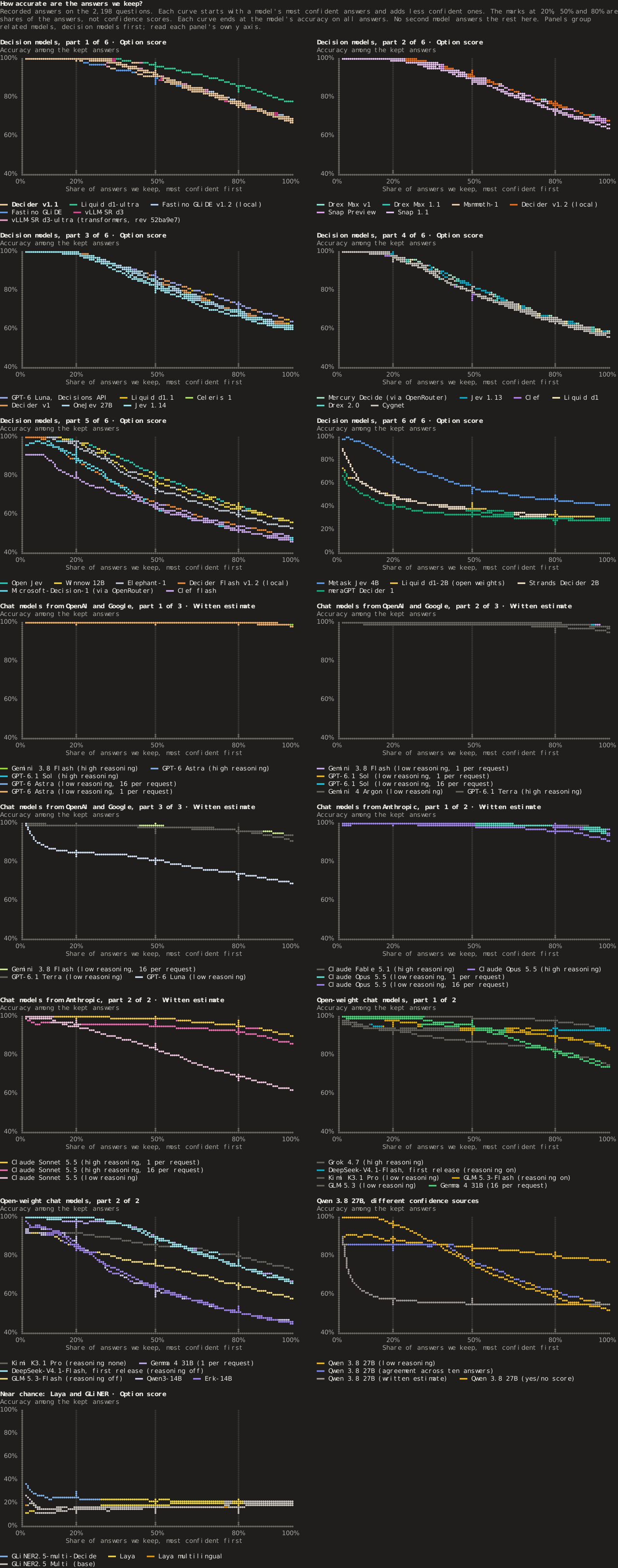
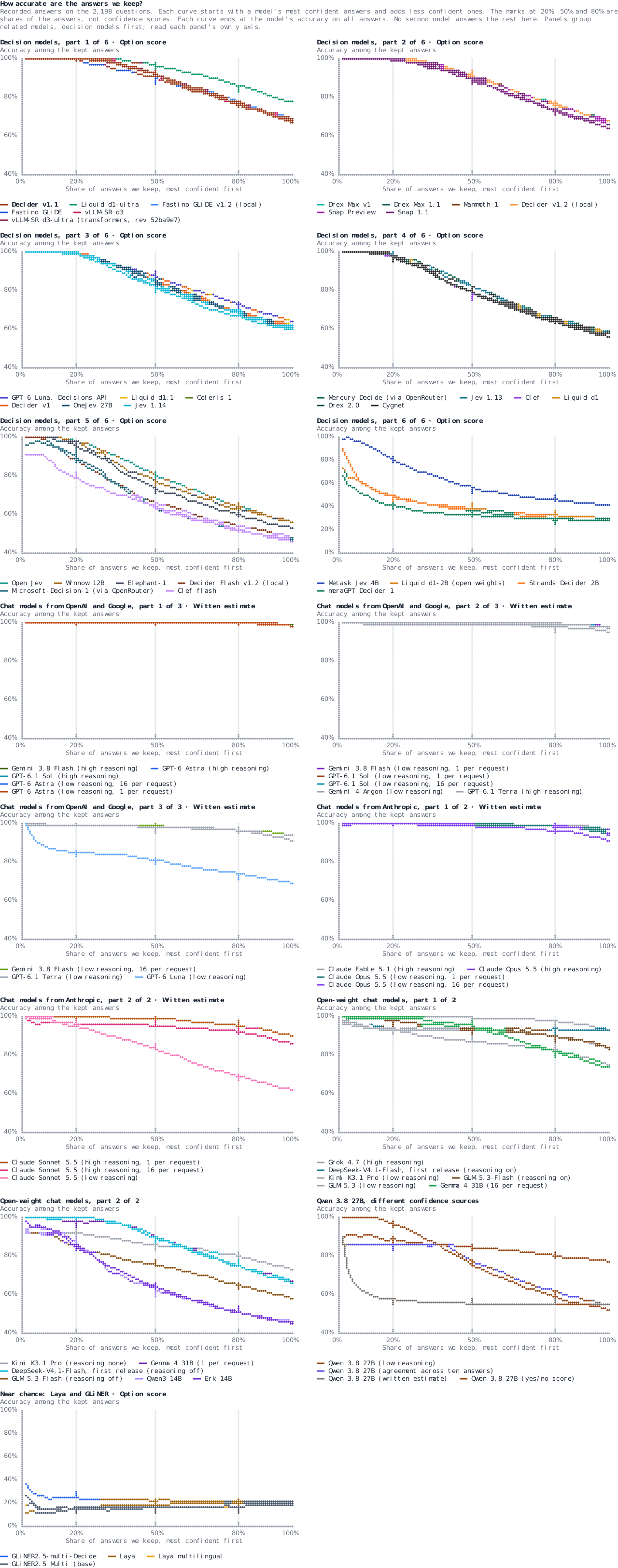
Keeping only the most confident answers is called selective prediction.10 The most confident 20% takes that share of answers with the highest scores and checks how many are right; the 50% and 80% shares work the same way. They describe the kept answers only.
Calibration
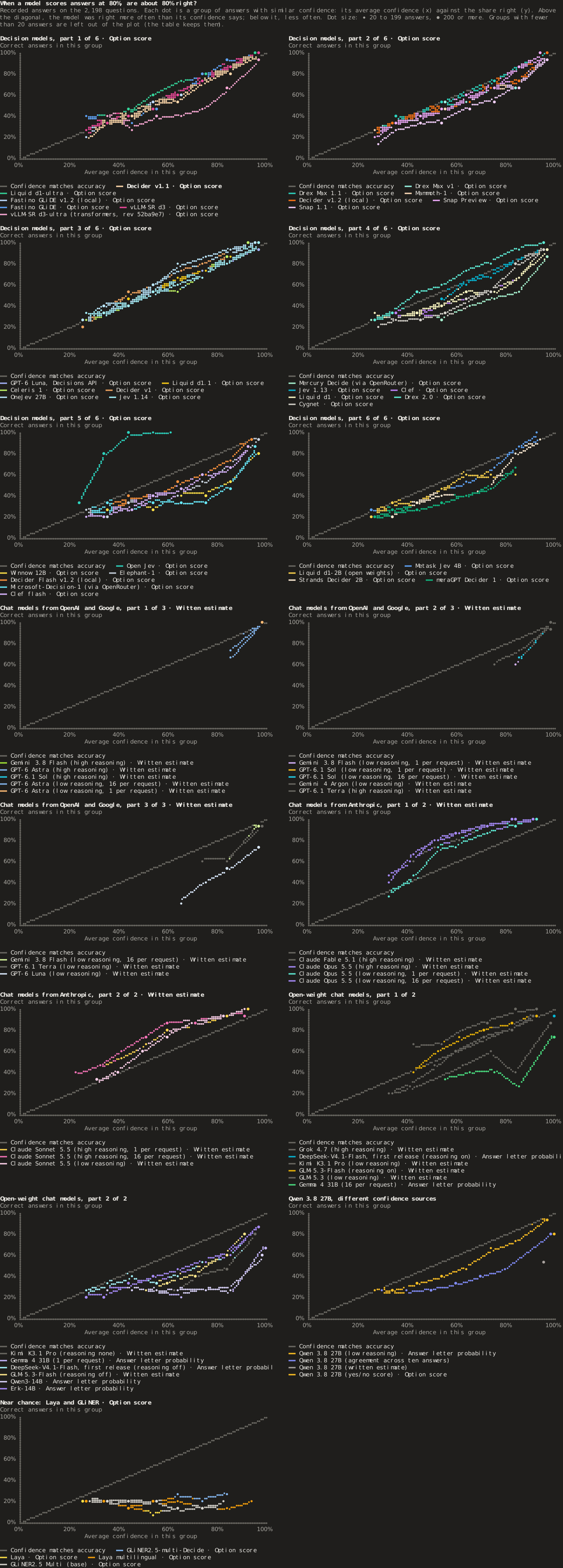
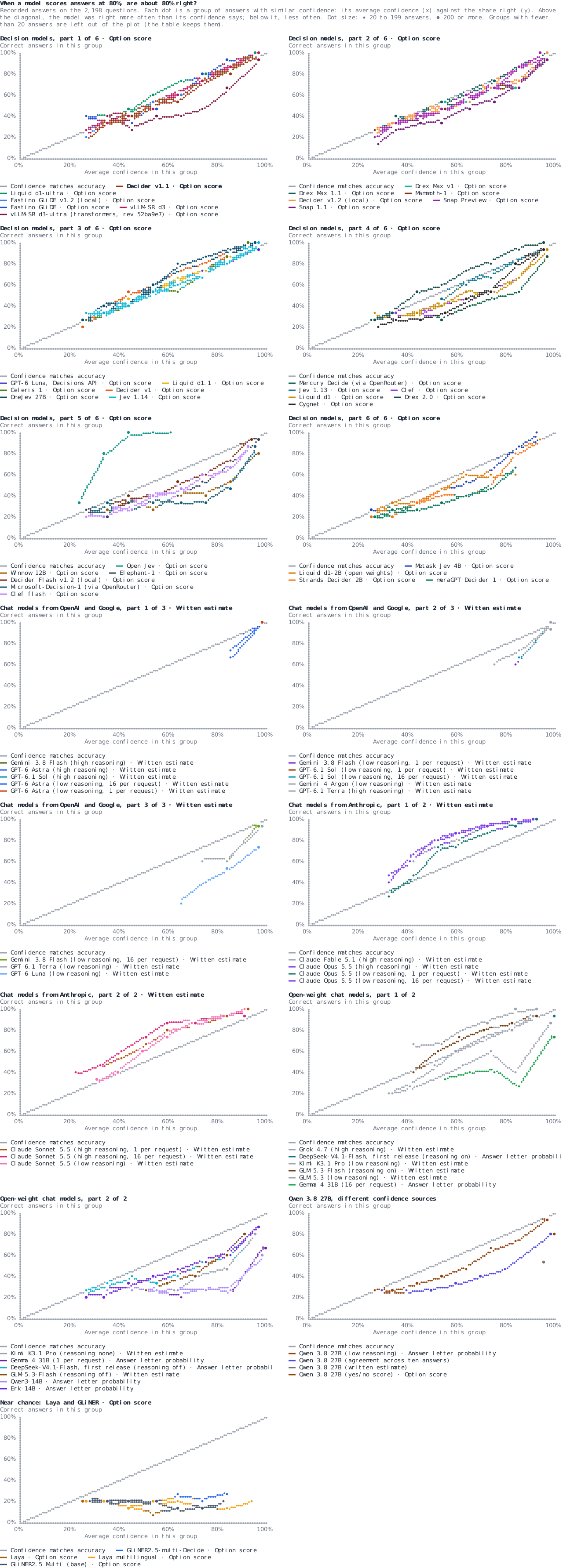
Calibration means that a model's confidence matches how often its answers are right. When a calibrated model says 80%, it is right about 80% of the time. Calibration matters when someone uses the number itself, for example to decide how much to risk on an answer.
Calibration is separate from accuracy: a model can be right often and still give probabilities that are too high or too low. It is also separate from ranking: a model can usually put right answers above wrong ones and still give probabilities of the wrong size.
| Question | Column | Better |
|---|---|---|
| Does the confidence put right answers above wrong ones? | Ranking score | Higher |
| Do the probabilities match the hit rate, as shipped? | Calibration gap | Lower |
| After a refit, do the probabilities beat one fixed probability for every answer? | Better than a flat guess | Higher |
Calibration asks whether the percentages match the hit rate: of 100 answers scored near 80%, about 80 should be right. The calibration gap (ECE)11 sorts answers into ten confidence groups (0% to below 10%, and so on) and compares each group's average confidence with its share right. It averages these gaps, weighting larger groups more, in points. Zero means a match within the groups, not that every score is right; the chart leaves out groups with fewer than 20 answers.
What a refit is
A refit changes the confidence scores, not the model's answers. The published ranking score still uses the original scores.
The refit has three steps. Before the conversion, probabilities are clipped to between 0.000001 and 0.999999. First, each confidence p becomes log-odds: ln(p / (1 − p)). Second, the new log-odds are a stretch times the old log-odds, plus a shift. Third, the result becomes a probability again. This is Platt scaling.21 Logistic regression chooses the stretch and the shift. With a positive stretch, the refit keeps the order of the scores it is applied to. With a negative stretch, it flips that order; these models are marked "reversed".
Example: Open-Jev 27B v1.1. Its confidence usually ranked right answers above wrong ones (ranking score 0.82), but its probabilities were too low. Fitted on all questions, its stretch is 4.42 and its shift is 4.30. The table refits each answer, then averages within each band:
| Raw score | Answers | Raw average | Average after refit | Actually right |
|---|---|---|---|---|
| 20–30% | 1,332 | 24.7% | 35.1% | 35.3% |
| 30–40% | 486 | 34.4% | 79.3% | 78.2% |
| 40–50% | 200 | 44.7% | 96.2% | 97.0% |
| 50–60% | 144 | 54.3% | 99.3% | 100% |
| 60–70% | 36 | 61.9% | 99.8% | 100% |
This table illustrates a fit on all questions. The published results come from a different calculation. We divide the questions into five parts, keeping questions from the same passage together; each question without a shared passage forms its own group. We fit on four parts and measure on the fifth, and rotate until each part has been measured once. Each part has its own stretch and shift; for Open-Jev the stretch ranges from 4.33 to 4.51. On those held-out questions, Open-Jev's calibration gap falls from 24.5 to 1.0 points.
A refit cannot raise accuracy.
Better than a flat guess
Better than a flat guess compares two probability errors on those held-out questions (5 folds by passage). The Brier score is the mean squared difference between a probability and the outcome (1 if right, 0 if wrong); lower is better. The flat guess gives every answer the same probability: the model's accuracy on the questions used for fitting. Better than a flat guess = 100 × (1 − Brier after refit ÷ Brier of the flat guess), so 0% means no improvement over the flat guess and below 0% means worse. Every model uses the same five parts, and questions without a score are left out, as in the calibration gap. Hamel Husain's post on decision models also found that calibration did not improve every model.
High accuracy does not by itself force this score to be low. The score measures how much the refitted probabilities reduce Brier error compared with the model's own flat baseline. Example: GPT-6 Astra (low reasoning, 16 questions per request) is right 97.6% of the time and scores 19.0%, while Gemini 3.8 Flash (high reasoning, 16 questions per request) is right 98.1% of the time and scores 6.5%. For models with few wrong answers, the score rests on few cases (Gemini 3.8 Flash: 42 of 2,198), so it can vary more between test sets. A score near 0% means this refit gave no improvement in this test. It does not prove that no method could make the confidence useful.
All calibration results
| Setup | Calibration gap (points) | Gap after refit (points) | Brier after refit | Brier of the flat guess | Better than a flat guess (%) |
|---|---|---|---|---|---|
| Open-Jev 27B v1.11 question per request | 24.5 | 1.0 | 0.168 | 0.247 | 31.9 |
| SubQ Snap 1.11 question per request | 11.2 | 2.0 | 0.158 | 0.231 | 31.5 |
| Perplexity Decider 27B v1.11 question per request | 3.8 | 1.6 | 0.152 | 0.222 | 31.5 |
| Perplexity Decider 27B v11 question per request | 5.0 | 2.2 | 0.165 | 0.239 | 31.0 |
| Perplexity Decider 27B v1.2local · 1 question per request | 4.4 | 2.6 | 0.154 | 0.221 | 30.5 |
| Qwen3.8-27Byes/no scoring · 1 question per request | 8.9 | 1.5 | 0.174 | 0.250 | 30.5 |
| Fastino GLiDE v1.2local · 1 question per request | 2.9 | 2.5 | 0.151 | 0.216 | 30.3 |
| OneJev 27B1 question per request | 5.5 | 2.6 | 0.168 | 0.241 | 30.3 |
| vLLM-SR d31 question per request | 2.6 | 2.7 | 0.153 | 0.219 | 30.0 |
| Drex Max 1.11 question per request | 2.9 | 3.0 | 0.154 | 0.220 | 29.9 |
| Mammoth-11 question per request | 5.6 | 2.1 | 0.156 | 0.221 | 29.5 |
| vLLM-SR d3-ultratransformers, rev 52ba9e7 · 1 question per request | 12.5 | 3.3 | 0.154 | 0.219 | 29.3 |
| SubQ Snap Preview1 question per request | 4.9 | 2.6 | 0.161 | 0.227 | 29.0 |
| DeepSeek-V4.1-Flash, first releasereasoning off · 16 questions per request | 13.5 | 2.2 | 0.160 | 0.225 | 28.9 |
| Jev 1.13.01 question per request | 5.1 | 2.2 | 0.174 | 0.245 | 28.9 |
| Inception Mercury Decidevia OpenRouter · 1 question per request | 15.5 | 3.6 | 0.173 | 0.243 | 28.8 |
| Drex 2.01 question per request | 4.2 | 2.0 | 0.177 | 0.247 | 28.5 |
| Drex Max v11 question per request | 6.3 | 2.1 | 0.157 | 0.219 | 28.3 |
| GPT-6 LunaDecisions API, beta · 1 question per request | 2.4 | 2.4 | 0.166 | 0.232 | 28.2 |
| Cygnet1 question per request | 13.8 | 3.0 | 0.178 | 0.247 | 27.8 |
| Liquid d1.11 question per request | 2.0 | 2.0 | 0.172 | 0.237 | 27.4 |
| Liquid d1-ultra1 question per request | 3.6 | 1.4 | 0.129 | 0.177 | 27.4 |
| Celeris-1 Decision1 question per request | 4.3 | 3.6 | 0.175 | 0.239 | 27.0 |
| Elephant-11 question per request | 11.8 | 1.9 | 0.183 | 0.249 | 26.5 |
| Liquid d11 question per request | 10.2 | 1.9 | 0.181 | 0.245 | 26.3 |
| Qwen3.8-27Bvote share · reasoning off · 1 question per request | 22.5 | 1.3 | 0.183 | 0.248 | 26.3 |
| Jev 1.14.01 question per request | 2.5 | 1.6 | 0.179 | 0.242 | 25.8 |
| Winnow-12B1 question per request | 19.7 | 6.3 | 0.186 | 0.247 | 24.6 |
| Clef1 question per request | 10.7 | 3.7 | 0.185 | 0.245 | 24.5 |
| Gemma 4 31Breasoning off · 16 questions per request | 24.2 | 6.4 | 0.149 | 0.197 | 24.5 |
| Fastino GLiDE1 question per request | 4.5 | 3.4 | 0.165 | 0.218 | 24.3 |
| Claude Sonnet 5.5low reasoning · 16 questions per request | 7.9 | 1.5 | 0.181 | 0.237 | 23.9 |
| Gemma 4 31Breasoning off · 1 question per request | 31.2 | 6.2 | 0.170 | 0.222 | 23.3 |
| Claude Opus 5.5low reasoning · 1 question per request | 10.2 | 0.5 | 0.049 | 0.062 | 22.3 |
| Erk-14Breasoning off · 16 questions per request | 13.5 | 1.6 | 0.193 | 0.248 | 21.9 |
| Perplexity Decider Flash v1.2local · 1 question per request | 8.3 | 2.8 | 0.195 | 0.250 | 21.9 |
| Microsoft-Decision-1via OpenRouter · 1 question per request | 19.8 | 5.1 | 0.195 | 0.249 | 21.8 |
| Metask-Jev 4B1 question per request | 5.8 | 3.5 | 0.194 | 0.242 | 19.6 |
| Claude Opus 5.5low reasoning · 16 questions per request | 16.5 | 1.3 | 0.070 | 0.086 | 19.2 |
| GPT-6 Astralow reasoning · 16 questions per request | 0.8 | 0.5 | 0.019 | 0.024 | 19.0 |
| Qwen3-14Breasoning off · 16 questions per request | 41.0 | 4.6 | 0.203 | 0.248 | 18.5 |
| Claude Sonnet 5.5high reasoning · 1 question per request | 9.8 | 0.8 | 0.079 | 0.097 | 18.1 |
| Clef-flash1 question per request | 15.5 | 2.3 | 0.205 | 0.249 | 17.6 |
| Gemini 4 Argonlow reasoning · 16 questions per request | 2.2 | 0.5 | 0.029 | 0.035 | 17.2 |
| Claude Sonnet 5.5high reasoning · 16 questions per request | 16.0 | 2.0 | 0.106 | 0.127 | 16.5 |
| GLM-5.3-Flashreasoning off · 16 questions per request | 21.0 | 1.7 | 0.204 | 0.244 | 16.2 |
| GPT-6 Astralow reasoning · 1 question per request | 1.3 | 0.3 | 0.021 | 0.025 | 16.2 |
| GLM-5.3low reasoning · 16 questions per request | 2.6 | 2.6 | 0.160 | 0.190 | 15.7 |
| Claude Opus 5.5high reasoning · 16 questions per request | 14.6 | 0.7 | 0.040 | 0.048 | 15.2 |
| Kimi K3.1 Prolow reasoning · 16 questions per request | 12.6 | 2.6 | 0.121 | 0.143 | 15.2 |
| GPT-6.1 Terralow reasoning · 16 questions per request | 6.0 | 1.5 | 0.071 | 0.083 | 14.1 |
| Claude Fable 5.1high reasoning · 16 questions per request | 12.0 | 0.5 | 0.032 | 0.037 | 14.0 |
| Grok 4.7high reasoning · 16 questions per request | 11.9 | 1.3 | 0.058 | 0.068 | 13.6 |
| Kimi K3.1 Proreasoning none · 16 questions per request | 20.1 | 2.2 | 0.172 | 0.199 | 13.5 |
| GLM-5.3-Flashreasoning on · 16 questions per request | 4.5 | 1.2 | 0.118 | 0.137 | 13.5 |
| GPT-6.1 Sollow reasoning · 16 questions per request | 1.5 | 1.0 | 0.028 | 0.032 | 11.9 |
| GPT-6.1 Sollow reasoning · 1 question per request | 1.8 | 0.8 | 0.028 | 0.032 | 11.4 |
| GPT-6.1 Terrahigh reasoning · 16 questions per request | 2.8 | 0.5 | 0.048 | 0.054 | 11.1 |
| GPT-6 Lunalow reasoning · 16 questions per request | 25.7 | 1.6 | 0.196 | 0.217 | 9.4 |
| GPT-6.1 Solhigh reasoning · 16 questions per request | 1.0 | 0.6 | 0.020 | 0.022 | 8.9 |
| Strands Decider 2B1 question per request | 12.2 | 1.1 | 0.183 | 0.200 | 8.5 |
| GPT-6 Astrahigh reasoning · 16 questions per request | 0.7 | 0.6 | 0.019 | 0.020 | 7.7 |
| Gemini 3.8 Flashlow reasoning · 1 question per request | 0.6 | 0.8 | 0.026 | 0.028 | 6.6 |
| Gemini 3.8 Flashhigh reasoning · 16 questions per request | 1.1 | 0.9 | 0.018 | 0.019 | 6.5 |
| Liquid d1-2B (open weights)1 question per request | 5.8 | 1.4 | 0.195 | 0.208 | 6.2 |
| Gemini 3.8 Flashlow reasoning · 16 questions per request | 3.5 | 0.8 | 0.060 | 0.063 | 4.4 |
| meraGPT Decider 11 question per request | 14.3 | 0.6 | 0.191 | 0.198 | 3.5 |
| Qwen3.8-27Blow reasoning · 16 questions per request | 23.3 | 2.3 | 0.173 | 0.179 | 3.2 |
| Qwen3.8-27Bstated confidence · reasoning off · 1 question per request | 40.8 | 0.9 | 0.247 | 0.248 | 0.5 |
| GLiNER2.5 Multi (base)1 question per request | 35.6 | 0.5 | 0.144 | 0.144 | 0.3reversed |
| Laya1 question per request | 13.2 | 0.8 | 0.154 | 0.154 | 0.2reversed |
| GLiNER2.5-multi-Decide1 question per request | 23.1 | 0.7 | 0.161 | 0.161 | 0.2 |
| DeepSeek-V4.1-Flash, first releasereasoning on · 16 questions per request | 8.0 | 0.6 | 0.073 | 0.073 | 0.1 |
| Laya multilingual1 question per request | 27.7 | 0.8 | 0.147 | 0.147 | 0.1reversed |
What a score of 99% or more meant
At 99% or more, Jev 1.13 got 311 of 312 right (1,886 skipped), d1 273 of 274 (1,924 skipped), Decider v1 21 of 21 (2,177 skipped) and GLiDE 121 of 121 (2,077 skipped); Luna got 365 of 368 through the Decisions API (1,830 skipped) and 693 of 830 writing its confidence (1,368 skipped). Few answers leave wide intervals: the 95% interval for the error rate is 0% to 15.5% for Decider v1 and 0% to 3.1% for GLiDE.
Gemma's letter probability reached 99% on 1,782 answers, 1,450 of them right (about 81%), and fell short of it on 416, which the 99% cutoff skips. DeepSeek with reasoning gave every answer at least 99% (2,198 kept, 0 skipped), and about 92% were right.
Can another confidence method make the same answers easier to judge?
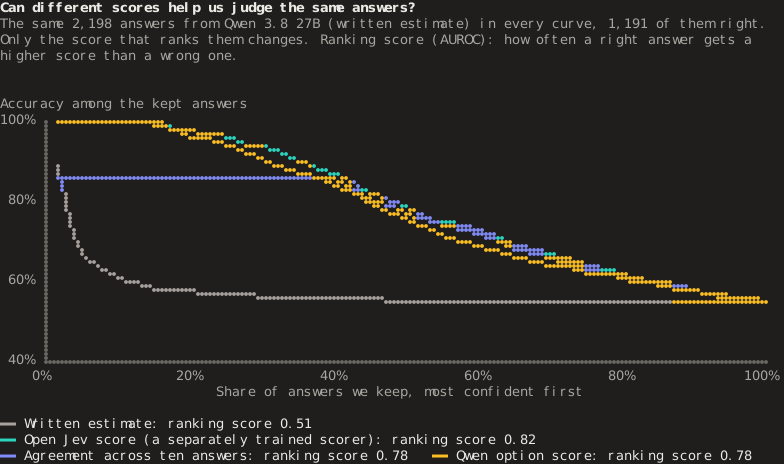
We scored one fixed set of Qwen 3.8 27B answers, 1,191 right of 2,198, four ways. The ranking score was about 0.51 for written confidence, 0.78 for Qwen's option score, 0.78 for agreement across ten answers and 0.82 for Open Jev, a separately trained model. Written confidence tends to bunch at high values,12 while large models' answer probabilities can match their hit rates well.13
The most common of ten answers scored 54.3%, against 54.2% for written confidence, and only about 85% were right when all ten agreed. Several answers can repeat one mistake.
How we tell a score gap from ordinary variation
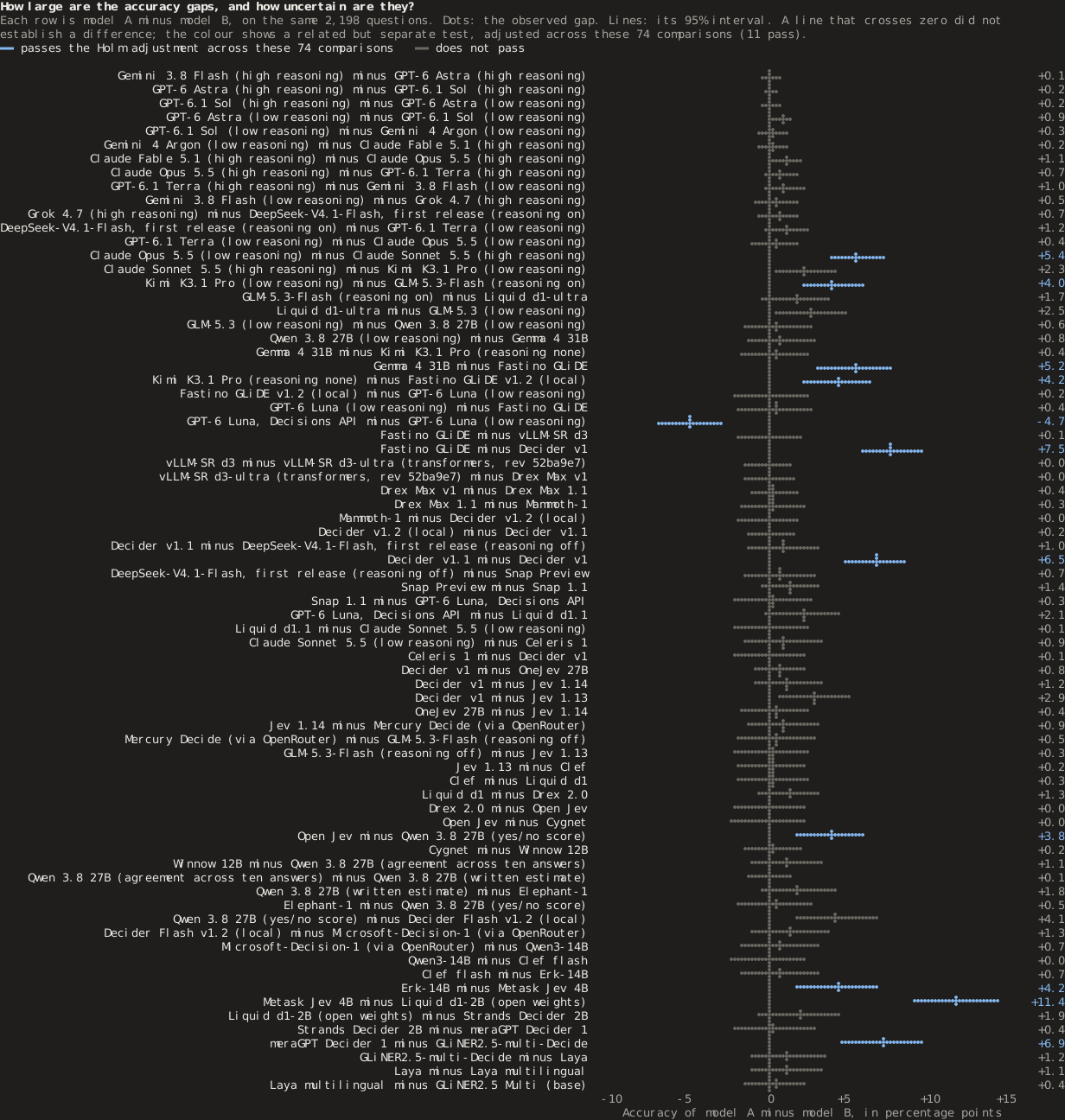
Both models answer the same questions, so we look at the questions only one got right. The exact McNemar test17 asks whether that split is too uneven for equal accuracy. Holm's method adjusts the p values for the number of tests: across 74 selected comparisons, and across all 2,701 pairs for the comparison groups (setups sharing a letter). A result from one set does not carry over to the other.
Astra scored 0.9 points above Sol: of 36 questions only one got right, Astra had 28 and Sol 8. The p value was 0.0012 before adjustment; adjusted, it was 0.074 among the selected comparisons and 0.32 across all pairs, both above 0.05. A p value says how unusual so uneven a split would be at equal accuracy, not the chance that the models are equal.
DeepSeek with reasoning scored 1.2 points above GPT-6.1 Terra with low reasoning (adjusted p 1). Not establishing a difference does not show equal accuracy: many language comparisons have too few questions to detect gaps this small.18
How we measure uncertainty
A result from one question set is an estimate. For the ranking score and the accuracy of kept answers, we draw 1,000 bootstrap samples of the questions with replacement, keeping the 14 questions of seven shared passages together. For small groups, such as answers at 99% or more, a Wilson interval gives an error rate above zero even with no mistakes. A 95% interval comes from a method that covers the true value in about 95% of repeated studies, under its assumptions; it is not a model's confidence.
The live tests report their comparisons without Holm's adjustment. Replays with a cutoff chosen on half the questions average 300 random splits of this one question set, not new question sets.
How we chose which answers to keep
A cheap model answers first; we keep its answer when its confidence reaches a cutoff, and a stronger model answers the rest. FrugalGPT5 and RouteLLM6 study related routing. We count the first model's cost on every question.
Three rules set the cutoff. The cutoff chosen on half the questions is chosen on one random half (a passage's questions together) and tested on the other, 300 times. The most confident quarter keeps the first model's 25% surest answers, and the fixed 99% rule every answer at 99% or more.
These are replays of recorded answers, with no new calls. The accuracy change compares the combined answers with the second model alone on the same questions. The estimated cost adds both models' calls, without the hardware of a first model we ran ourselves.
The average-cost caveat
Replay savings give every question passed to the second model the same average cost. In the live tests, the passed questions cost more, so the savings were smaller in eight of nine tests.
In the live tests, the second model answered the passed questions with new calls, on one split of 1,099 questions, and separately answered all of them alone. One split checks the replay; it cannot replace the average over 300.
The second model changes the result: in front of Claude Sonnet 5.5 at high reasoning, GLiDE answered 44.6% of the questions and Gemma 60.9%. The best pair depends on the task and the loss you accept.
Does a decision model's uncertainty (entropy over its option scores) point to the questions a stronger model gets wrong? Weakly: its most uncertain 10% of questions held 11% to 19% of those where Opus, Sonnet or Astra erred, against about 10% by chance.
Cost and reasoning
We report output tokens, request time and money separately. Services charge by tokens, but token counts of different models do not stand for equal computation.
What changes when a model does more reasoning?
| Model and setup | Reasoning setting | Correct answers overall | Grammar accuracy | Output tokens per question | Estimated cost per 1,000 questions in US dollars | Request time for this test (requests whose answers were kept) |
|---|---|---|---|---|---|---|
| Claude Sonnet 5.5 | low reasoning | 61.4% | 52.2% | 22 | $1.90 | 9.6 min |
| Claude Sonnet 5.5 | high reasoning | 85.0% | 85.0% | 199 | $3.65 | 58 min |
| DeepSeek-V4.1-Flash, first release | reasoning off | 65.9% | 56.6% | 6 | No dollar estimate; see hardware and time | 12 min |
| DeepSeek-V4.1-Flash, first release | reasoning on | 92.0% | 91.4% | 1,006 | No dollar estimate; see hardware and time | 114 min, 8 simultaneous requests |
| Gemini 3.8 Flash | low reasoning | 93.3% | 92.5% | 28 | $0.27 | 5.5 min |
| Gemini 3.8 Flash | high reasoning | 98.1% | 98.5% | 601 | $2.42 | 43 min, 4 simultaneous requests |
| GLM-5.3-Flash | reasoning off | 57.8% | 47.4% | 19 | No dollar estimate; see hardware and time | 2.5 min |
| GLM-5.3-Flash | reasoning on | 78.8% | 74.3% | 1,010 | No dollar estimate; see hardware and time | 64 min, 8 simultaneous requests |
Reasoning helped grammar much more than reading. In all four pairs we tested, the grammar gain was larger, and every 95% interval of the difference is above 0. Claude Sonnet 5.5, low to high reasoning: +32.7 points on grammar, +2.3 on reading. For DeepSeek and GLM, turning on reasoning also turns on random sampling, so those pairs mix two changes.
| Pair | Reading gain (points) | Grammar gain (points) | Difference (grammar gain minus reading gain, points) | 95% interval of the difference |
|---|---|---|---|---|
| Claude Sonnet 5.5, low → high reasoning | +2.3 | +32.7 | +30.5 | +26.8 to +34.3 |
| DeepSeek-V4.1-Flash, first release, reasoning off → on | +5.6 | +34.8 | +29.2 | +25.6 to +32.8 |
| Gemini 3.8 Flash, low → high reasoning | +2.0 | +6.0 | +4.0 | +2.2 to +5.8 |
| GLM-5.3-Flash, reasoning off → on | +7.2 | +26.9 | +19.7 | +15.9 to +23.2 |
Each interval is a paired bootstrap over the scored questions (1,000
resamples, each shared passage's questions kept together). The results file holds them, and reproduce.py
recomputes them.
Short output can go with high accuracy: GPT-6 Astra reached 97.6% with about 21 output tokens per question, and GPT-6.1 Sol 96.7% with 25. Other research finds that more computation while answering helps on some problems;7 we show it only for these settings.
How we estimate the money cost
We multiply each run's recorded tokens by published prices, in US dollars per 1,000 questions asked, including the 12 questions later removed. We use the token counts services reported, without checking invoices; GPT and Claude ran on subscriptions, so we price the same use at API rates. Rates for new, reused and stored input apply separately.
Most rates date from 8 October 2026 and 18 October 2026. Perplexity's price changed between its Decider v1 and v1.1 runs, so their cost difference is not only a model improvement. Gemini 3.8 Flash's price is introductory: it doubles on 1 January 2027, to $1.50 input and $7.50 output per 1M tokens.
Models on our own GPUs get a dollar estimate only where the model's maker lists a price for the same model: Alibaba for Qwen3.8-27B; Fastino for GLiDE v1.2; Nace.AI for Drex Max v1; Baseten for Mammoth-1 and Elephant-1; Perplexity for Decider v1.2 and Decider Flash v1.2; and Cloudflare for Clef and Clef-flash. Perplexity bills 3 input tokens per request more than our servers count, so we add them. Each is estimated at its maker's list price for the same model, from our recorded tokens; our hardware cost is not measured. The other models on our GPUs get no estimate, which does not make them free. Liquid d1: the run used the free tier (d1:free); its cost is now estimated at Liquid's list price for the same model. Fixed output token charges of some decision services follow pricing rules, not written reasoning.
- A service may save input so a later call can reuse it. It may charge one rate to save it and another to read it again.
- Elephant-1. Prices recorded 1 November 2026. Per one million tokens: input $0.035; output free. Source: Baseten's list price for the same model.
- Mammoth-1. Prices recorded 1 November 2026. Per one million tokens: input $0.10; output free. Source: Baseten's list price for the same model.
- Celeris-1 Decision. Prices recorded 10 October 2026. Per one million tokens: input $0.04; output free. Source: Celeris's decision model price.
- Claude Fable 5.1. Prices recorded 28 October 2026. Per one million tokens: input $10; reused input $0.25; saving input for reuse $12.50 for 5 minutes, $20 for 1 hour; output $50. Source: Anthropic's API list price.
- Claude Opus 5.5, Claude Opus 5.5 (1 question per request), Claude Opus 5.5 (16 questions per request). Prices recorded 8 October 2026. Per one million tokens: input $4; reused input $0.20; saving input for reuse $5 for 5 minutes, $8 for 1 hour; output $20. Source: Anthropic's API list price.
- Claude Sonnet 5.5 (1 question per request), Claude Sonnet 5.5 (16 questions per request), Claude Sonnet 5.5. Prices recorded 8 October 2026. Per one million tokens: input $2; reused input $0.10; saving input for reuse $2.50 for 5 minutes, $4 for 1 hour; output $10. Source: Anthropic's API list price.
- Clef. Prices recorded 18 October 2026. Per one million tokens: input $0.24; output free. Source: Cloudflare's list price for the same model.
- Clef-flash. Prices recorded 18 October 2026. Per one million tokens: input $0.038; output free. Source: Cloudflare's list price for the same model.
- Drex Max v1. Prices recorded 30 October 2026. Per one million tokens: input $0.06; output free. Source: Nace.AI's list price for the same model.
- Fastino GLiDE. Prices recorded 8 October 2026. Per one million tokens: input $0.15; output free. Source: Fastino's GLiDE price. Provider update: $0.04 per 1M input tokens since, as listed on 22 October 2026.
- Gemini 3.8 Flash, Gemini 3.8 Flash (1 question per request), Gemini 3.8 Flash (16 questions per request). Prices recorded 8 October 2026. Per one million tokens: input $0.75; reused input $0.075; output $3.75. Source: Google's Gemini API price, introductory. Provider update: doubles on 1 January 2027, to $1.50 input and $7.50 output per 1M tokens.
- Gemini 4 Argon. Prices recorded 28 October 2026. Per one million tokens: input $4; reused input $0.20; output $20. Source: Google's Gemini API regular price (from 1 December 2026). Provider update: introductory until 30 November 2026: $2.00 input, $10.00 output and $0.10 cached input per 1M tokens.
- Fastino GLiDE v1.2 (local). Prices recorded 22 October 2026. Per one million tokens: input $0.04; output free. Source: Fastino's list price for the same model.
- Jev 1.13.0. Prices recorded 8 October 2026. Per one million tokens: input $0.042; output free. Source: TypeSafe's System One price.
- Jev 1.14.0. Prices recorded 16 October 2026. Per one million tokens: input $0.042; output free. Source: TypeSafe's System One price.
- Liquid d1-ultra. Prices recorded 16 October 2026. Per one million tokens: input $0.042; output free. Source: Liquid AI's d1-ultra price.
- Liquid d1.1. Prices recorded 24 October 2026. Per one million tokens: input $0.02; output free. Source: Liquid AI's price for d1.1, as its API bills it.
- Liquid d1. Prices recorded 18 October 2026. Per one million tokens: input $0.02; output free. Source: Liquid's list price for the same model.
- meraGPT Decider 1. Prices recorded 19 October 2026. Per one million tokens: input $0.04; output free. Source: meraGPT's Decider 1 price.
- Drex Max 1.1. Prices recorded 30 October 2026. Per one million tokens: input $0.06; output free. Source: Nace.AI's list price (launch price $0.03 per 1M input tokens, 50% off, is what Nace bills).
- Drex 2.0. Prices recorded 30 October 2026. Per one million tokens: input $0.06; output free. Source: Nace.AI's list price.
- GPT-6 Astra, GPT-6 Astra (16 questions per request), GPT-6 Astra (1 question per request). Prices recorded 8 October 2026. Per one million tokens: input $10; reused input $1; saving input for reuse $12.50; output $50. Source: OpenAI's API list price.
- GPT-6 Luna. Prices recorded 8 October 2026. Per one million tokens: input $0.10; reused input $0.01; saving input for reuse $0.125; output $0.50. Source: OpenAI's API list price.
- GPT-6.1 Sol, GPT-6.1 Sol (1 question per request), GPT-6.1 Sol (16 questions per request). Prices recorded 8 October 2026. Per one million tokens: input $2; reused input $0.10; saving input for reuse $2.50; output $10. Source: OpenAI's API list price.
- GPT-6.1 Terra. Prices recorded 28 October 2026. Per one million tokens: input $1; reused input $0.05; saving input for reuse $1.25; output $5. Source: OpenAI's API list price.
- GPT-6 Luna (Decisions API, beta). Prices recorded 8 October 2026. Per one million tokens: input $0.10; output free. Source: OpenAI's Decisions API price.
- Inception Mercury Decide (via OpenRouter). Prices recorded 17 October 2026. Per one million tokens: input $0.02; output free. Source: OpenRouter's Mercury Decide price.
- Microsoft-Decision-1 (via OpenRouter). Prices recorded 17 October 2026. Per one million tokens: input $0.042; output free. Source: OpenRouter's Microsoft-Decision-1 price.
- Kimi K3.1 Pro. Prices recorded 28 October 2026. Per one million tokens: input $2; reused input $0.20; output $10. Source: OpenRouter's price for Moonshot AI's endpoint (mxfp4).
- GLM-5.3. Prices recorded 28 October 2026. Per one million tokens: input $0.98; reused input $0.182; output $3.08. Source: OpenRouter's price for Fireworks' spot endpoint, which served nearly every request.
- Perplexity Decider 27B v1. Prices recorded 4 October 2026. Per one million tokens: input $0.04; output free. Source: Perplexity's Decisions API price. Provider update: $0.02 per 1M input tokens since, as listed on 8 October 2026.
- Perplexity Decider 27B v1.1. Prices recorded 9 October 2026. Per one million tokens: input $0.02; output free. Source: Perplexity's Decisions API price.
- Perplexity Decider Flash v1.2 (local). Prices recorded 18 October 2026. Per one million tokens: input $0.01; output free. Source: Perplexity's list price for the same model. Billed input: 3 tokens per request more than our count, which we add.
- Perplexity Decider 27B v1.2 (local). Prices recorded 18 October 2026. Per one million tokens: input $0.02; output free. Source: Perplexity's list price for the same model. Billed input: 3 tokens per request more than our count, which we add.
- SubQ Snap 1.1. Prices recorded 1 November 2026. Per one million tokens: input $0.04; output free. Source: SubQ's list price.
- SubQ Snap Preview. Prices recorded 13 October 2026. Per one million tokens: input $0.05; output free. Source: SubQ's Decisions API price.
- Qwen3.8-27B. Prices recorded 18 October 2026. Per one million tokens: input $0.50; reused input $0.10; output $3. Source: Alibaba's list price for the same model.
- Qwen3.8-27B (stated confidence). Prices recorded 18 October 2026. Per one million tokens: input $0.50; reused input $0.10; output $3. Source: Alibaba's list price for the same model.
- Qwen3.8-27B (vote share). Prices recorded 18 October 2026. Per one million tokens: input $0.50; reused input $0.10; output $3. Source: Alibaba's list price for the same model.
- Qwen3.8-27B (yes/no scoring). Prices recorded 18 October 2026. Per one million tokens: input $0.50; reused input $0.10; output $3. Source: Alibaba's list price for the same model.
- Grok 4.7. Prices recorded 28 October 2026. Per one million tokens: input $2; reused input $0.50; output $6. Source: xAI's API list price.
- DeepSeek-V4.1-Flash, first release, GLM-5.3-Flash, Gemma 4 31B (16 questions per request), vLLM-SR d3, vLLM-SR d3-ultra (transformers, rev 52ba9e7), Gemma 4 31B (1 question per request), OneJev 27B, Cygnet, Open-Jev 27B v1.1, Winnow-12B, Qwen3-14B, Erk-14B, Metask-Jev 4B, Liquid d1-2B (open weights), Strands Decider 2B, GLiNER2.5-multi-Decide, Laya, Laya multilingual, GLiNER2.5 Multi (base). No dollar estimate; see hardware and time.
What can these results tell us about understanding?
A model may answer a passage question correctly and miss a grammar rule in the same language: performance changes by task, which does not settle whether it understands. These tests measure skills models have, not how fast they learn; Mitchell and Krakauer discuss meanings of understanding,1 and Chollet separates a skill from the ability to learn new ones.2
Reading may draw on patterns shared across languages, and school grammar more on local rules; training, difficulty and format could also explain the gap. Confidence changes too: Jev 1.13's ranking score fell from 0.89 on Reading to 0.72 on Grammar, and Open Jev's from 0.89 to 0.75. An Arize evaluation reports a stronger score for Jev 1.13 on two-label English tasks, a different test.
Stronger evidence would change a question's words but not the relationship the answer depends on, then change that relationship and check the answer follows (CheckList9; McCoy, Pavlick and Linzen14). Teaching an unfamiliar rule would test learning directly. Other work looks inside models15 or tests generalisation across wording and reasoning problems.16
What changed when we repeated the same questions?
We ran 30 of the 47 one-question-per-request setups five times on all 2,198 questions, and 12 of the 27 setups with 16 per request five times on a fixed 200-question set.
On all questions, Open Jev changed no answers, Decider v1 two answers and SubQ Snap Preview nine answers; Jev 1.13 changed about 14%, d1 10%, Celeris 1 9%, Qwen's yes or no scoring 7% and Qwen with written confidence 44 answers (2%). Decider v1.2 (local) changed no answers, Decider Flash v1.2 (local) no answers, Mercury Decide about 9% and Microsoft-Decision-1 about 13%. On the 200-question set, Astra changed 1 question, Opus 20 questions and Sonnet with high reasoning 31 questions. A model can repeat the same wrong answer, so stability alone proves little.
Gemma's stored repeats, in one server session, changed 0 questions; an unsaved rerun after a restart changed some. The Gemma and DeepSeek repeats have no confidence scores.
How we measure latency and throughput
Latency is the time from sending one request to receiving its answer, measured from our computer, network and any retries within the request included; a request holds one question or 16. Request time is the time at least one request was in flight, over the requests whose answers were kept, overlaps counted once. It is not a run's elapsed time: it leaves out requests that failed and any pause before a run was resumed. Throughput is answered questions per minute of request time.
DeepSeek-V4.1-Flash, first release (reasoning on) and GLM-5.3-Flash (reasoning on) sent eight requests at a time. Gemini 3.8 Flash (high reasoning), Grok 4.7 (high reasoning), Kimi K3.1 Pro (low reasoning), GLM-5.3 (low reasoning), Qwen3.8-27B (low reasoning), Kimi K3.1 Pro (reasoning none), Fastino GLiDE and GPT-6 Luna (Decisions API, beta) sent four requests at a time. These choices, along with hardware, network conditions and service limits, affect the measured throughput.
Some early runs recorded the total time but not the time of each request. For those, we take latencies from later runs of the same setup. Perplexity Decider 27B v1, Jev 1.13.0, Liquid d1, Open-Jev 27B v1.1, Qwen3.8-27B (stated confidence, reasoning off), Qwen3.8-27B (yes/no scoring), Laya and Laya multilingual use their four later repeat runs on all 2,198 questions. With 16 questions per request, GPT-6 Astra (low reasoning), Claude Opus 5.5 (low reasoning), Claude Sonnet 5.5 (high reasoning) and Claude Sonnet 5.5 (low reasoning) use their five repeat runs on the same 200 questions.
Astra's typical latency is 13.0 seconds for 16 questions (from the 200-question repeats) and 6.14 for one; Gemma's is 3.97 and 0.295 seconds.
What these results do not establish
The questions are online, so models may have seen them in training (contamination, which few tests measure19); turning off web access cannot undo that. On the 40 Turkish questions of Turkey's June 2026 university entrance exam, public before our October test, 14 models got 24 to 40 right. Of the five we added in October and checked this way, d1-ultra got 34, Jev 1.14 31, Decider v1.2 (local) 31, Decider Flash v1.2 (local) 28 and GLiDE v1.2 (local) 33. These 40 questions are a separate check, not part of the 2,198.
When we replaced the correct option's text with a copy of a wrong one, Astra chose the original letter 31.0% of the time and the copy 28.4% on the 1,660 questions whose options are text, with no established preference (p = 0.19). On the same questions, d1-ultra (12.2% and 11.9%), Jev 1.14 (8.4% and 9.3%), Decider v1.2 (local; 11.3% and 11.2%), Decider Flash v1.2 (local; 8.6% and 7.2%) and GLiDE v1.2 (local; 9.2% and 8.0%) showed no established preference either (p from 0.16 to 1). On the 328 questions whose options are single numerals, Astra, d1-ultra and Decider v1.2 chose the original letter more often, which the numerals' fixed order can explain. That checks one form of recall, not whether the model knew the question.
Reasoning, sampling, request size, precision, server software and server state can change answers. This is one language and one question source; a confidence cutoff for a new task needs its own test.
Download the data and check our calculations
Results updated 3 November 2026 · Results snapshot 0bdaa447 · Question set questions-v2.sqlite (797ad6c8) · Answer key version 2
The results file holds the summary numbers; the answer export holds the recorded choices, confidence scores, settings, prompt templates and question IDs, without the copyrighted questions. The metric code computes each statistic; the Data page describes the files.
This snapshot holds 74 main setups, 180 extra repeat runs, 20 runs from the 14 live tests, two cheaper models tested alone and two more runs with one question per request on 200 questions.
From the repository, reproduce.py recomputes every main
setup's accuracy, ranking score, calibration gap before and after the refit, Brier scores and answers at 99% or
more (before and after the key review),
the 74 selected comparisons, comparison groups, request format comparisons, reasoning pairs, repeats, prices,
replays with their 300 splits and live tests: all 31,366 checks match. It does not yet check the
bootstrap intervals of the ranking score and the accuracy of kept answers.
The 40 exam questions stay private, and the raw replies behind token counts are not exported.
The runner folder holds the test code, run scripts and server wrappers.
Sources and related research
These sources explain the methods and the earlier research above; our measurements come from the recorded runs.
- Mitchell, M., & Krakauer, D. C. (2023). The debate over understanding in AI's large language models. Proceedings of the National Academy of Sciences, 120(13), e2215907120. https://doi.org/10.1073/pnas.2215907120 ↩
- Chollet, F. (2019). On the Measure of Intelligence. arXiv:1911.01547. https://arxiv.org/abs/1911.01547 ↩
- Yüksel, A., Köksal, A., Şenel, L. K., Korhonen, A., & Schütze, H. (2024). TurkishMMLU: Measuring Massive Multitask Language Understanding in Turkish. Findings of EMNLP 2024. https://aclanthology.org/2024.findings-emnlp.413/ ↩
- Liang, P., et al. (2023). Holistic Evaluation of Language Models. Transactions on Machine Learning Research. https://arxiv.org/abs/2211.09110 ↩
- Chen, L., Zaharia, M., & Zou, J. (2023). FrugalGPT: How to Use Large Language Models While Reducing Cost and Improving Performance. arXiv:2305.05176. https://arxiv.org/abs/2305.05176 ↩
- Ong, I., et al. (2024). RouteLLM: Learning to Route LLMs with Preference Data. arXiv:2406.18665. https://arxiv.org/abs/2406.18665 ↩
- Snell, C., Lee, J., Xu, K., & Kumar, A. (2024). Scaling LLM Test-Time Compute Optimally can be More Effective than Scaling Model Parameters. arXiv:2408.03314. https://arxiv.org/abs/2408.03314 ↩
- Zheng, C., Zhou, H., Meng, F., Zhou, J., & Huang, M. (2024). Large Language Models Are Not Robust Multiple Choice Selectors. ICLR 2024. https://arxiv.org/abs/2309.03882 ↩
- Ribeiro, M. T., Wu, T., Guestrin, C., & Singh, S. (2020). Beyond Accuracy: Behavioral Testing of NLP Models with CheckList. Proceedings of ACL, pp. 4902–4912. https://aclanthology.org/2020.acl-main.442/ ↩
- Geifman, Y., & El-Yaniv, R. (2017). Selective Classification for Deep Neural Networks. Advances in Neural Information Processing Systems 30. https://arxiv.org/abs/1705.08500 ↩
- Guo, C., Pleiss, G., Sun, Y., & Weinberger, K. Q. (2017). On Calibration of Modern Neural Networks. Proceedings of ICML, PMLR 70, 1321–1330. https://arxiv.org/abs/1706.04599 ↩
- Xiong, M., et al. (2024). Can LLMs Express Their Uncertainty? An Empirical Evaluation of Confidence Elicitation in LLMs. ICLR 2024. https://arxiv.org/abs/2306.13063 ↩
- Kadavath, S., et al. (2022). Language Models (Mostly) Know What They Know. arXiv:2207.05221. https://arxiv.org/abs/2207.05221 ↩
- McCoy, R. T., Pavlick, E., & Linzen, T. (2019). Right for the Wrong Reasons: Diagnosing Syntactic Heuristics in Natural Language Inference. Proceedings of ACL, pp. 3428–3448. https://aclanthology.org/P19-1334/ ↩
- Beckmann, P., & Queloz, M. (2026). Mechanistic indicators of understanding in large language models. Philosophical Studies, 183, 1747–1792. https://doi.org/10.1007/s11098-026-02513-1 ↩
- Blanck, R., & Noble, B. (2026). Logic, inference, understanding: cross-domain generalization for generative language models. Frontiers in Artificial Intelligence, 9, 1800372. https://doi.org/10.3389/frai.2026.1800372 ↩
- Dietterich, T. G. (1998). Approximate Statistical Tests for Comparing Supervised Classification Learning Algorithms. Neural Computation, 10(7), 1895–1923. https://doi.org/10.1162/089976698300017197 ↩
- Card, D., Henderson, P., Khandelwal, U., Jia, R., Mahowald, K., & Jurafsky, D. (2020). With Little Power Comes Great Responsibility. Proceedings of EMNLP 2020, pp. 9263–9274. https://aclanthology.org/2020.emnlp-main.745/ ↩
- Sainz, O., et al. (2023). NLP Evaluation in trouble: On the Need to Measure LLM Data Contamination for each Benchmark. Findings of EMNLP 2023. https://arxiv.org/abs/2310.18018 ↩
- Northcutt, C. G., Athalye, A., & Mueller, J. (2021). Pervasive Label Errors in Test Sets Destabilize Machine Learning Benchmarks. NeurIPS 2021 Datasets and Benchmarks Track. https://arxiv.org/abs/2103.14749 ↩
- Platt, J. (1999). Probabilistic Outputs for Support Vector Machines and Comparisons to Regularized Likelihood Methods. In Advances in Large Margin Classifiers, MIT Press. https://doi.org/10.7551/mitpress/1113.003.0008 ↩